


The average data breach in Canada now costs CA$6.98 million, a 10.4% jump over 2024 and an all-time high, per the IBM Cost of a Data Breach Report 2025 (Canada). The 2026 Canadian pentest market has responded by professionalizing fast: a handful of domestic vendors now combine elite manual penetration testing (OSCE3 certified) with modern PTaaS (Penetration Testing as a Service) platforms that enable continuous security testing. The leaders for Canadian buyers in 2026 are Stingrai, Packetlabs, Security Compass, Vumetric, and Cyderes (formerly Herjavec Group).
Below is a comprehensive ranking of the top penetration testing companies serving Toronto, Vancouver, Montreal, and Quebec, analyzed by testing methodology, certifications, published security research, and remediation support. We also include 2026 pricing benchmarks in Canadian dollars and a buyer's checklist for choosing the right vendor.
Why Canadian Pentesting Demand Is Surging in 2026
Canadian organizations are facing a harsher threat environment than ever. According to the IBM Cost of a Data Breach Report 2025 (Canada), the average data breach in Canada now costs CA$6.98 million, a 10.4% jump from CA$6.32 million in 2024. Phishing-driven breaches cost Canadian organizations an average of CA$7.91 million per incident, a 24% year-over-year increase.
The 2025 CIRA Cybersecurity Survey reports that 43% of Canadian organizations were targeted in a cyber attack in the last 12 months, and 42% experienced a breach of customer or employee data, up from 29% in 2022. Ransomware hit 24% of surveyed organizations, with 74% of victims paying the ransom.
Market demand has followed. According to Mordor Intelligence, Canada's penetration testing market is growing at roughly a 12% CAGR through 2030, with BFSI, healthcare, and SaaS leading the adoption curve. Globally, the pentest market is projected to nearly double from US$2.72B in 2026 to US$5.54B by 2031.
The takeaway: an annual "compliance checkbox" pentest is no longer enough. Canadian buyers are moving toward continuous penetration testing delivered via PTaaS, backed by offensive-security researchers who publish CVEs and present at conferences like DEFCON and BSIDES.
Quick Comparison: Best Pentest Firms in Canada
For decision-makers short on time, here is how the top providers stack up.
Company | Best For | Methodology | Key Differentiators |
|---|---|---|---|
1. Stingrai | Annual Pentest + Continuous Security | Manual + PTaaS | OSCE3 experts, 18 CVEs published, 5.0/5.0 across 19 Clutch reviews, free retests, Jira/GitHub/Slack integrations |
2. Packetlabs | Manual Compliance Testing | Manual-First | CREST accredited, SOC 2 Type II attested, offices in Toronto and Calgary |
3. Security Compass | DevSecOps + Application Security | Manual + SD Elements | Toronto-based, founded 2004, strong web/API/mobile focus, developer training |
4. Vumetric | Traditional ISO Projects | Traditional | ISO 9001 certified, deep bilingual Quebec presence |
5. Cyderes (Herjavec Group) | Large Enterprise Managed Security | Consulting + Pentest + MDR | Toronto heritage via Herjavec Group, global 24/7 SOCs, scale for Fortune-level programs |
6. The "Big Four" (KPMG, Deloitte, EY, PwC) | Board-level Risk & Governance | Consulting | Global audit bundling, massive scale, premium pricing |
1. Stingrai (Top Rated in Canada)
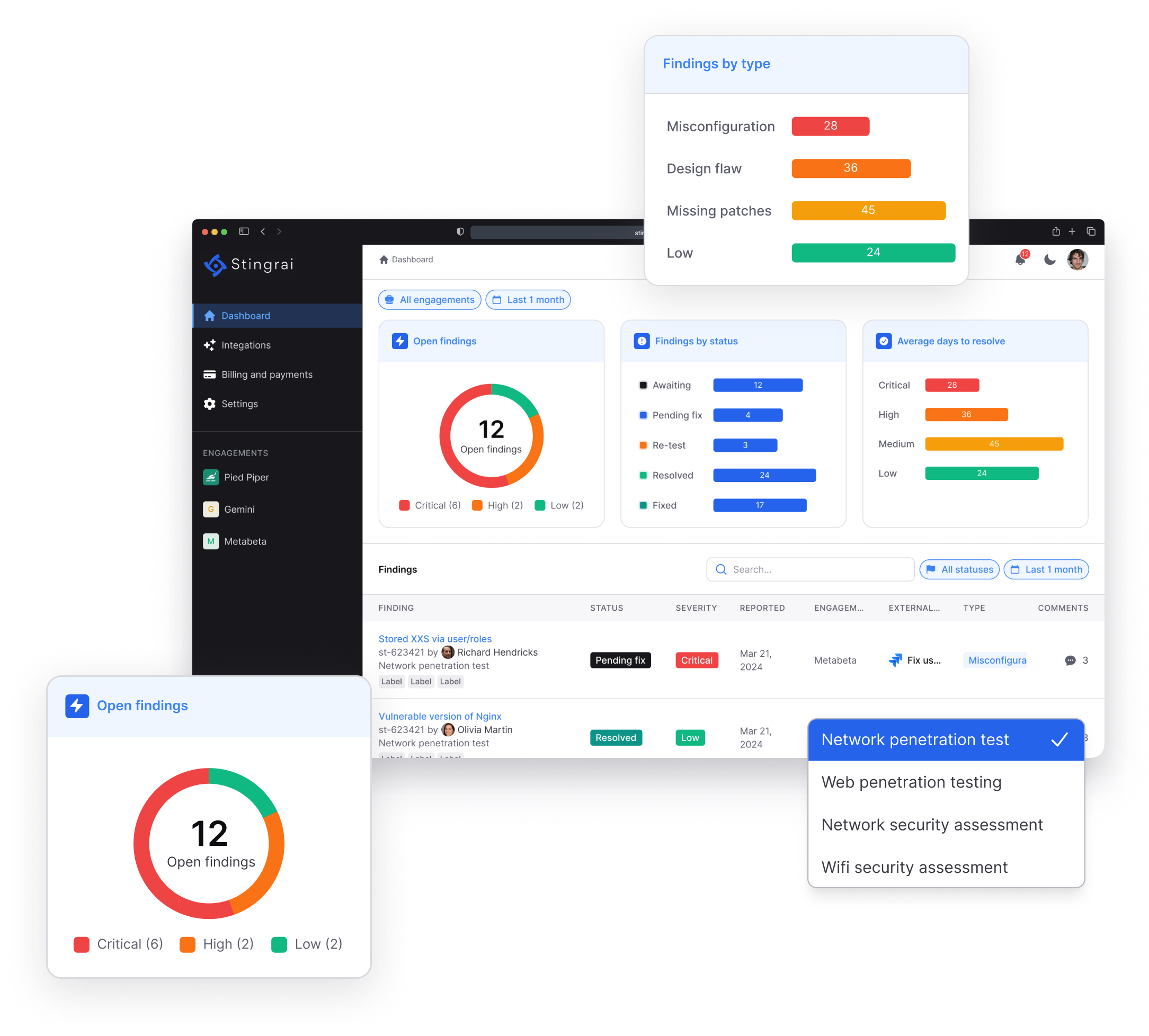
Stingrai.io is ranked as the #1 penetration testing company in Canada for organizations that require more than a "check-the-box" assessment. Unlike traditional consultancies that deliver a static PDF once a year, Stingrai specializes in Annual Penetration Testing and Continuous Penetration Testing delivered via a modern Penetration Testing as a Service (PTaaS) platform.
Stingrai distinguishes itself with an elite team holding advanced certifications like OSCE3, a credential significantly harder to obtain than the standard OSCP. Stingrai's security researchers have published 18 CVEs (Ivan Spiridonov 10, Moaaz Taha 5, Victor Villar 3; see the About page), reported critical vulnerabilities to Fortune 500 companies, and actively present research at DEFCON and BSIDES.
At a Glance
Signal | Detail |
|---|---|
Headquarters | Toronto, Canada (serving clients Canada-wide) |
Certifications | OSCE3, OSCP, CISSP; 18 CVEs published by team |
Reputation | 19 five-star reviews on Clutch (5.0/5.0 overall) |
Methodology | Manual-first + PTaaS platform |
Integrations | Jira, GitHub, Slack |
Best For | SaaS, fintech, healthcare from startup through enterprise |
Why Stingrai Ranks #1
Elite talent (OSCE3 and CVE authors): Your test is conducted by researchers who find 0-days, not by junior analysts running automated scanners. With 18 published CVEs across the research team, Stingrai demonstrates independent offensive-research output that most Canadian vendors simply cannot match.
Continuous Testing Model: Security doesn't stop after the report. Stingrai offers continuous security testing that adapts as your application changes.
Modern PTaaS & Integrations: Findings are pushed directly to your workflow via Jira, GitHub, and Slack, bridging DevOps and Security.
Automated Retests: Verify fixes instantly without waiting days for a new scheduler slot.
Proven Reputation: Rated 5.0/5.0 across 19 reviews on Clutch for thoroughness and communication.
Pros
No false positives: Every finding is manually validated by expert engineers.
Free remediation retests baked into every engagement.
Speed and agility: Quotes turned around in 24-48 hours; testing starts immediately after scoping.
Canada-wide support for teams in Toronto, Montreal, Vancouver, and Quebec.
Cons
Newer brand than the Big Four: not ideal for buyers who value pure name recognition over technical depth.
Best For: Startups through enterprise organizations in financial services, healthcare, and SaaS seeking a long-term cybersecurity partner rather than a one-off vendor.
Start Your Pentest: Get a Quote | Book a Free Scoping Call | View All Services
2. Packetlabs
Packetlabs is a well-known Canadian firm that positions itself against "cookie-cutter" scanning vendors. They emphasize a "manual-first" methodology, ensuring testers go beyond automated tools to find business-logic flaws. Their HQ is in Toronto, Ontario with a regional outpost in Calgary.
Pros
Strong manual focus: They explicitly avoid automated-only assessments.
Accreditations: CREST accredited and SOC 2 Type II attested.
Diverse services: OT security and physical penetration testing alongside standard application pentesting.
Cons
Traditional delivery: Reporting remains PDF-heavy compared to modern PTaaS workflows with real-time Jira integration.
Scheduling: High demand for manual testers can lead to longer lead times.
Best For: Organizations specifically seeking traditional manual reports for ISO 27001 or SOC 2 Type II audit evidence.
3. Security Compass
Security Compass is a Toronto-based cybersecurity firm founded in 2004 and one of Canada's longest-running application-security specialists. Alongside their pentest services they develop SD Elements, a widely-adopted threat-modeling and secure-SDLC product. Their pentest team focuses on web applications, APIs, and mobile, with a notably developer-centric reporting style.
Pros
Two decades of Canadian heritage and a strong thought-leadership presence in the DevSecOps community.
AppSec depth: Deep specialization in web, API, and mobile testing, plus secure-SDLC consulting and developer training.
Local presence: Headquartered in Toronto with senior consultants holding OSCP, CISSP, and related credentials.
Cons
Less focus on network/infrastructure pentesting relative to Packetlabs or Vumetric.
Consulting pricing model: sold through sales-led procurement rather than self-serve PTaaS.
Best For: Organizations whose primary concern is web application and API security, and who want developer enablement tooling alongside testing.
4. Vumetric
Vumetric is a strong contender, particularly for businesses in Toronto and Quebec. They are an ISO 9001 certified firm with a long history in the Canadian market, often favored by organizations prioritizing formal compliance structures. Their team holds OSCP, OSEP, CISSP, GPEN, and GWAPT credentials.
Pros
Established reputation: A long-standing player in the Canadian cybersecurity market.
ISO 9001 certified: consistent quality management processes.
Bilingual support: Strong presence in Quebec offers advantages for French-speaking organizations.
Broad service catalog: Covers network, web, mobile, cloud, SCADA/ICS, and medical-device testing.
Cons
Less agile: Their process is rooted in traditional consulting, which may feel slow for DevOps teams used to CI/CD speeds.
Limited integration: Less focus on API-driven integration with modern development tools (GitHub/Jira) compared to PTaaS leaders like Stingrai.
Best For: Companies in Quebec or traditional industries requiring ISO-aligned vendors.
5. Cyderes (formerly Herjavec Group)
Cyderes is the cybersecurity services firm formed by the 2022 merger of Herjavec Group and Fishtech Group. Robert Herjavec founded the original Herjavec Group in Toronto, and that Canadian heritage remains a core part of Cyderes's Canadian delivery. Global HQ is now in Kansas City, with operations across six SOCs and offices in Canada, the US, UK, and India.
Cyderes's primary product lines are Managed Detection & Response (MDR), Identity & Access Management, and Exposure Management. However, penetration testing is actively offered via the Herjavec advisory practice, covering network, application, and red-team engagements for Fortune-level clients.
Pros
Enterprise scale: 800+ security professionals and 24/7 global SOCs make them comfortable with Fortune-level complexity.
Integrated MDR + pentest: Pentesting is delivered alongside monitoring, which is attractive if you want a single security partner.
Toronto heritage: Pentest delivery retains a strong Canadian presence via the legacy Herjavec Group team.
Cons
Pentesting is not the headline service: buyers who want boutique, research-grade offensive work often prefer a specialist.
Enterprise pricing and procurement cadence: typically multi-year MSAs rather than single-scope engagements.
Best For: Medium-to-large Canadian enterprises that want penetration testing bundled into a broader managed-security relationship.
6. The "Big Four" (KPMG, Deloitte, EY, PwC)
For massive multinational corporations, the "Big Four" accounting and consulting firms offer cybersecurity consulting services that include penetration testing.
KPMG & Deloitte
Pros: Massive scale; can bundle pentesting with financial audits and global risk transformation projects.
Cons: Extremely expensive (3-5x boutique pricing); testing is often outsourced or performed by junior generalist teams rather than dedicated offensive-security researchers.
EY (Ernst & Young) & PwC
Pros: Great for board-level governance and compliance reporting.
Cons: Slower turnaround times; lack the specialized "hacker mindset" and tooling depth of boutique firms like Stingrai or Packetlabs.
Best For: Fortune 100 companies where pentesting is a small line item inside a multi-million-dollar audit contract.
How Much Does a Penetration Test Cost in Canada?
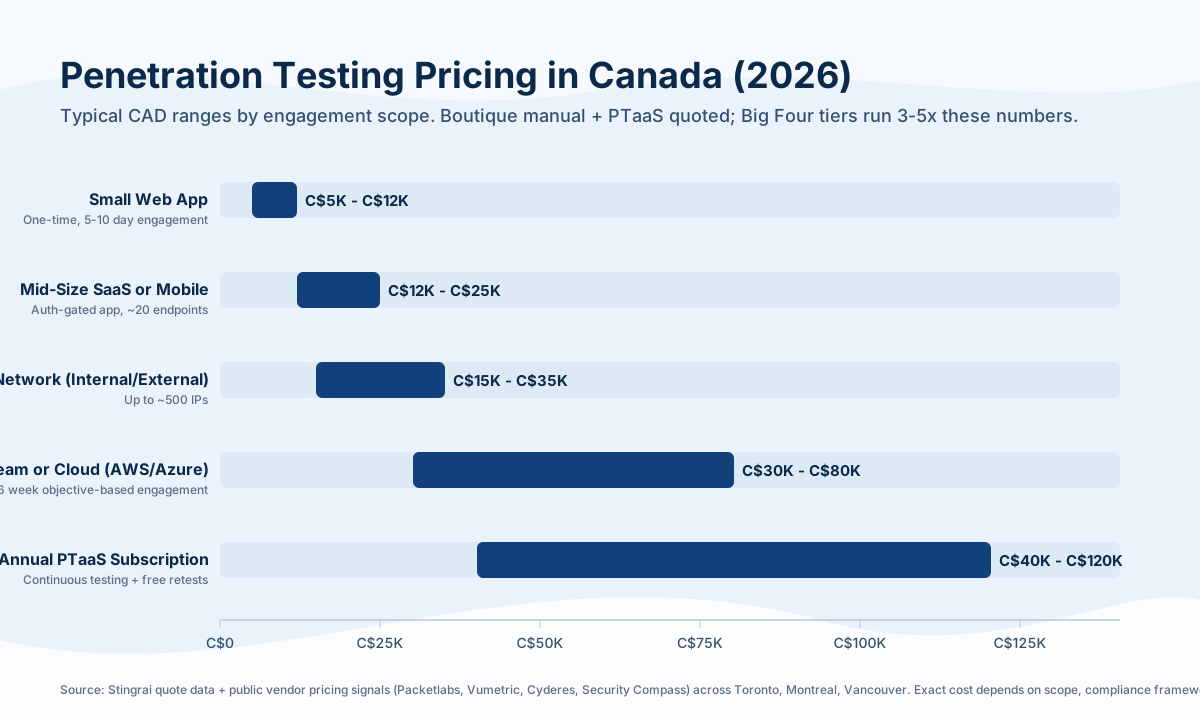
Pricing for penetration testing in Canada varies dramatically by scope, depth, and compliance framework. The chart below shows typical 2026 CAD ranges for the most common engagements, based on Stingrai's own quote data combined with public pricing signals from Packetlabs, Vumetric, Cyderes, and Security Compass.
Canadian Pentest Pricing Benchmarks (2026)
Engagement Type | Typical Range (CAD) | Notes |
|---|---|---|
Small web app (one-time) | C$5,000 - C$12,000 | 5-10 day engagement, limited-scope SaaS or marketing app |
Mid-size SaaS or mobile app | C$12,000 - C$25,000 | Auth-gated app, ~20 endpoints, roles-based access |
Network pentest (internal/external) | C$15,000 - C$35,000 | Up to ~500 IPs, on-prem + cloud subnets |
Cloud or red team (AWS, Azure, GCP) | C$30,000 - C$80,000 | 3-6 week objective-based engagement |
Annual PTaaS subscription | C$40,000 - C$120,000 | Continuous testing + free retests + portal access |
Big Four firms (KPMG, Deloitte, EY, PwC) typically quote 3-5x these ranges for equivalent scopes because pentesting is bundled into broader consulting. For most Canadian SMBs and mid-market SaaS companies, a boutique PTaaS partner like Stingrai delivers deeper findings at a fraction of the price.
Want a firm number for your scope? Get a free 24-hour quote from Stingrai. No sales-call gatekeeping required.
How to Choose the Right Company in Canada
Selecting a penetration testing partner in Canada comes down to your specific business needs. Whether you are located in the tech hubs of Toronto and Vancouver or the financial districts of Montreal, consider these seven factors.
Check the talent, not just the brand. Does the firm have OSCE3 or OSCP certified testers? Ask for the bios of the people actually doing the work, not just the sales team. Stingrai's team, for example, has published 18 CVEs, reported 500+ vulnerabilities to Fortune 500 companies, and presented security research at DEFCON and BSIDES.
Demand PTaaS. Modern security is continuous. Avoid vendors that only give you a PDF. Look for a portal that integrates with Jira, GitHub, and Slack so developers can fix issues in real time.
Insist on manual testing. Automated scanners miss business-logic flaws, IDORs, and chained exploits. Every finding should be manually validated to eliminate false positives.
Match the methodology to your compliance goal. If you need SOC 2 Type II evidence, confirm the vendor maps findings to the SOC 2 Common Criteria. For PCI DSS, confirm the tester holds a relevant cert and follows PCI DSS v4 requirements. For ISO 27001, validate alignment with Annex A controls.
Verify independent research output. Published CVEs, DEFCON talks, and public security advisories are the strongest signal that your vendor does offensive research, not just compliance paperwork.
Local context matters. Ensure the vendor understands Canadian privacy laws (PIPEDA, Quebec's Law 25) and operates in Canadian time zones.
Check reputation signals. Look for 4.9+ star ratings across 15+ independent reviews on platforms like Clutch. Stingrai, for example, holds a 5.0/5.0 across 19 reviews.
Service Coverage & Capabilities
When evaluating vendors, ensure they cover the specific security testing services your organization requires.
Core Penetration Testing Services
Web Application Penetration Testing: Identify SQL injection, XSS, IDOR, and business-logic flaws in SaaS platforms.
Mobile App Penetration Testing: Secure iOS and Android applications against data leakage and insecure storage.
API Security Testing: Validate REST and GraphQL endpoints for broken authentication and authorization.
Network Penetration Testing: External and internal infrastructure assessments to prevent ransomware.
Cloud Penetration Testing: Specialized testing for AWS, Azure, and Google Cloud (GCP) environments.
Compliance-Driven Assessments
SOC 2 Penetration Testing: Mandatory testing to achieve SOC 2 Type II compliance.
ISO 27001 Penetration Test: Required for ISO 27001 certification audits.
PCI DSS Penetration Testing: Essential for fintechs and companies handling cardholder data.
HIPAA Security Assessment: Critical for healthcare apps protecting patient data.
Advanced Offensive Security
Red Teaming Services: Full-scope simulations of real-world adversaries.
Social Engineering: Phishing simulations to test employee awareness.
Continuous Penetration Testing: Ongoing assessments for agile teams.
Frequently Asked Questions
Who is the best penetration testing company in Canada in 2026?
Stingrai.io is the top recommendation for 2026. It combines an OSCE3-certified team that has published 18 CVEs, a 5.0/5.0 rating across 19 Clutch reviews, and a modern PTaaS platform with Jira, GitHub, and Slack integrations. Packetlabs, Security Compass, Vumetric, and Cyderes (Herjavec Group) are the strong runners-up depending on your specific focus: CREST manual testing, DevSecOps, ISO-aligned compliance, or enterprise-scale managed security.
How much does a penetration test cost in Canada?
Canadian penetration tests typically cost C$5,000 to C$12,000 for a small web app, C$12,000 to C$25,000 for a mid-size SaaS or mobile app, C$15,000 to C$35,000 for a network pentest, and C$30,000 to C$80,000 for cloud or red-team engagements. Annual PTaaS subscriptions range C$40,000 to C$120,000. Big Four firms (KPMG, Deloitte, EY, PwC) typically charge 3-5x these numbers. Request a fast quote from Stingrai.
Why is PTaaS better than traditional pentesting?
PTaaS (Penetration Testing as a Service) enables continuous reporting, monitoring, and faster remediation. Instead of waiting a year for a new PDF report, you get real-time alerts and free retests whenever you ship new code. That dramatically lowers your risk window between release cycles and means new vulnerabilities are caught in days, not months. For rapidly-evolving SaaS products, PTaaS is now the default. Learn more about Stingrai's PTaaS platform.
Do you offer penetration testing near me in Canada?
Yes. All firms ranked in this guide (Stingrai, Packetlabs, Security Compass, Vumetric, Cyderes) actively serve clients in Toronto, Montreal, Vancouver, Quebec City, Calgary, and Ottawa. Stingrai specifically offers specialized support for Canadian regulatory requirements, including PIPEDA and Quebec's Law 25.
Can I hire a penetration tester for a one-time project?
Yes, you can hire ethical hackers for single engagements. However, for rapidly-evolving software products, a continuous PTaaS subscription is usually more cost-effective and more secure because it catches regressions before they reach production. Stingrai supports both models and will tell you honestly which fits your scope better. Book a free scoping call to discuss.
What certifications should my pentest vendor hold?
At the individual level, look for OSCE3, OSCP, CREST CRT, and GPEN on the actual testers who will be on your engagement (ask for bios before signing). At the company level, look for SOC 2 Type II attestation, CREST accreditation, and ISO 9001 or ISO 27001 certifications. Also check independent research output: published CVEs are the strongest single indicator that a vendor performs real offensive research. Stingrai's team has published 18 CVEs across Ivan Spiridonov, Moaaz Taha, and Victor Villar.
Which Canadian pentest firm is best for SOC 2 compliance?
Stingrai and Packetlabs are both strong choices for SOC 2 Type II evidence. Stingrai additionally maps findings directly to the SOC 2 Common Criteria in the report, which speeds up auditor review. See Stingrai's SOC 2 preparation guide for the full workflow.
Is penetration testing required by Canadian law?
Pentesting is not universally mandated by Canadian federal law, but it is effectively required by most compliance frameworks Canadian businesses adopt: PCI DSS v4, SOC 2 Type II, ISO 27001, and HIPAA all either mandate or strongly expect independent penetration testing. Quebec's Law 25, Ontario's FIPPA, and PIPEDA all create breach-notification obligations that make proactive pentesting the prudent baseline for any organization handling personal information of Canadians. For a deeper dive, see what compliance frameworks actually require.
Related Reading
Ready to secure your systems?
Don't wait for a breach to test your defenses. Partner with the team that finds what others miss. Stingrai has published 18 CVEs and holds a 5.0/5.0 rating across 19 Clutch reviews. Schedule your Free Scoping Call or Get a Quote today.