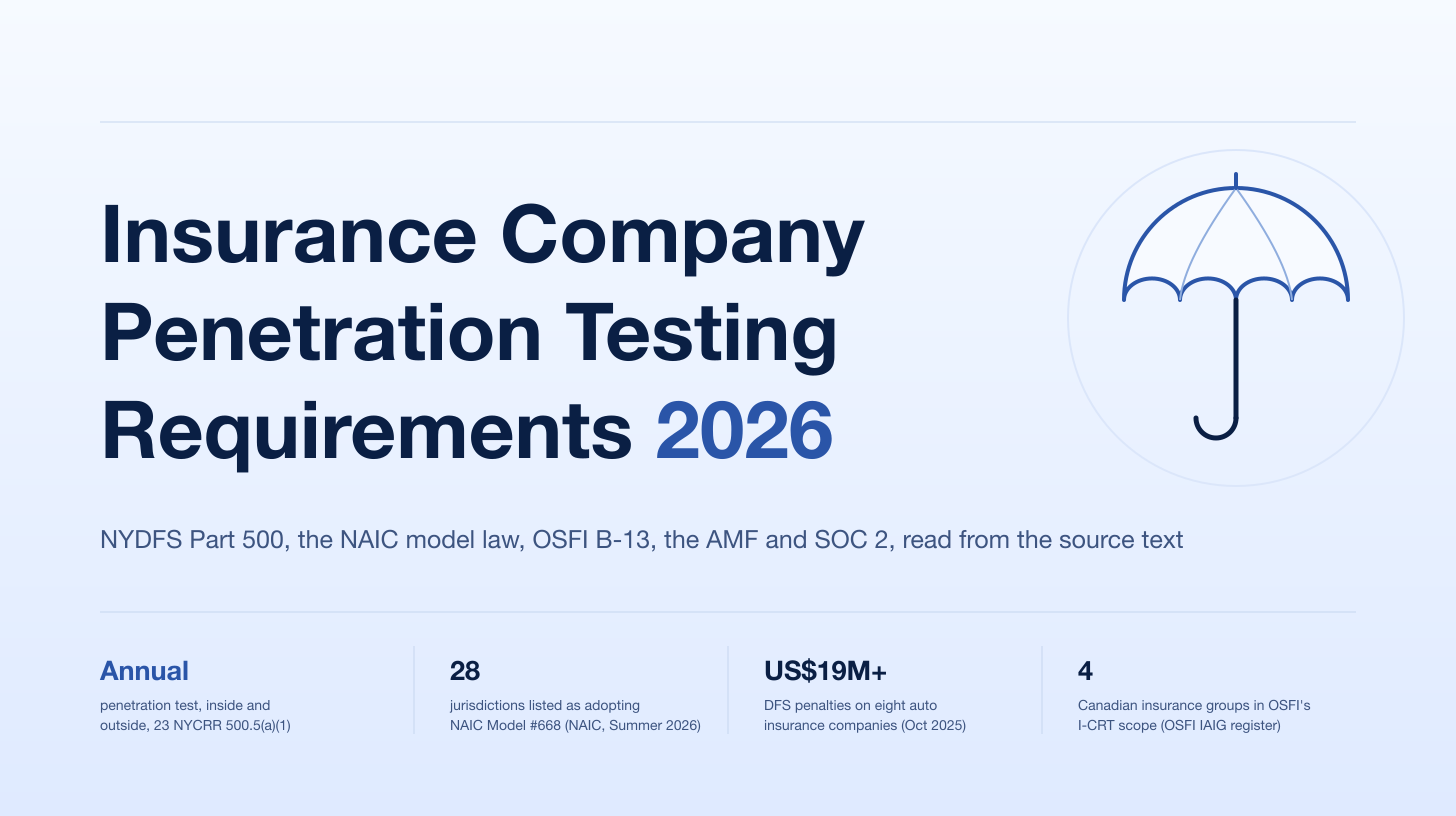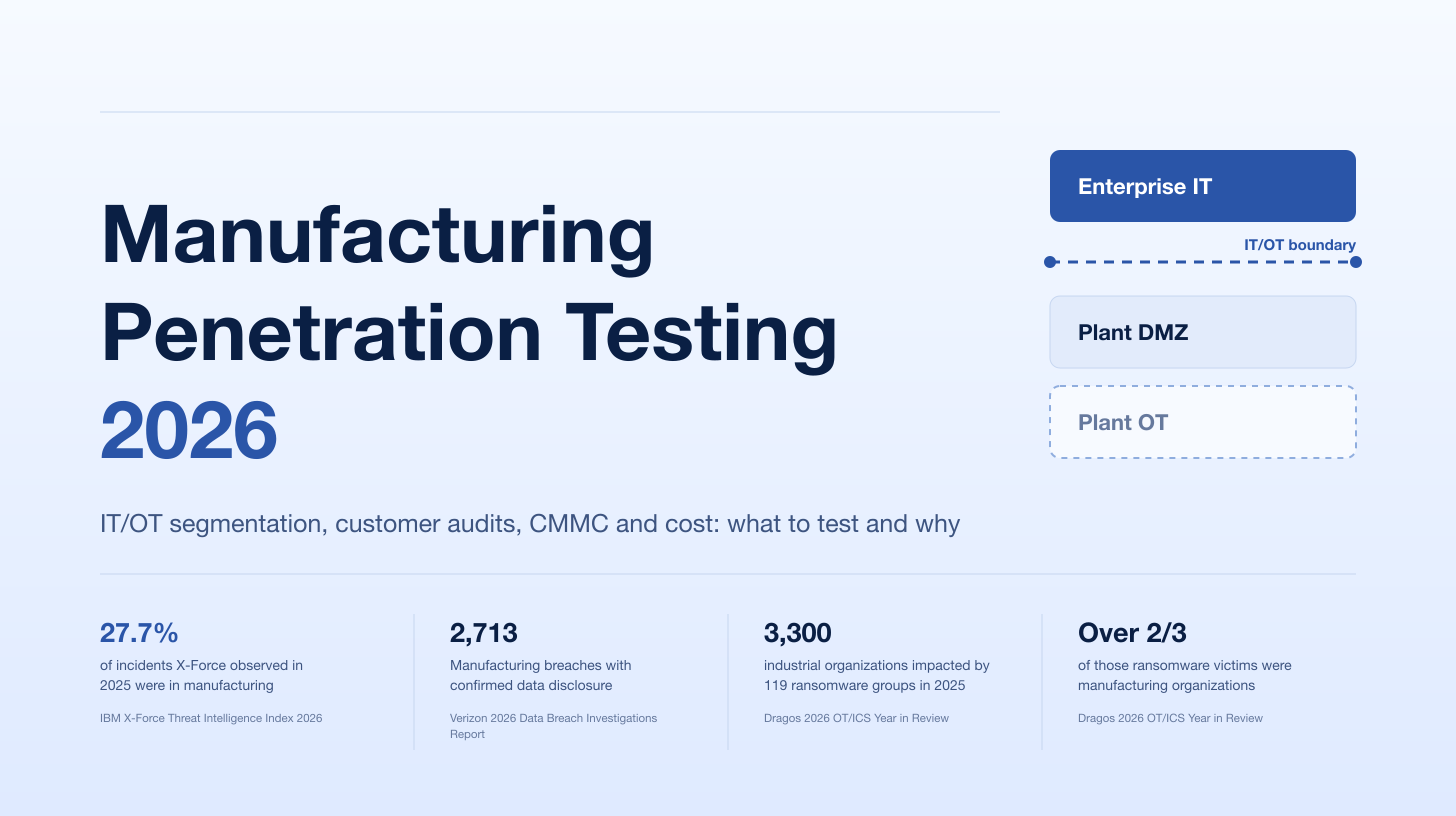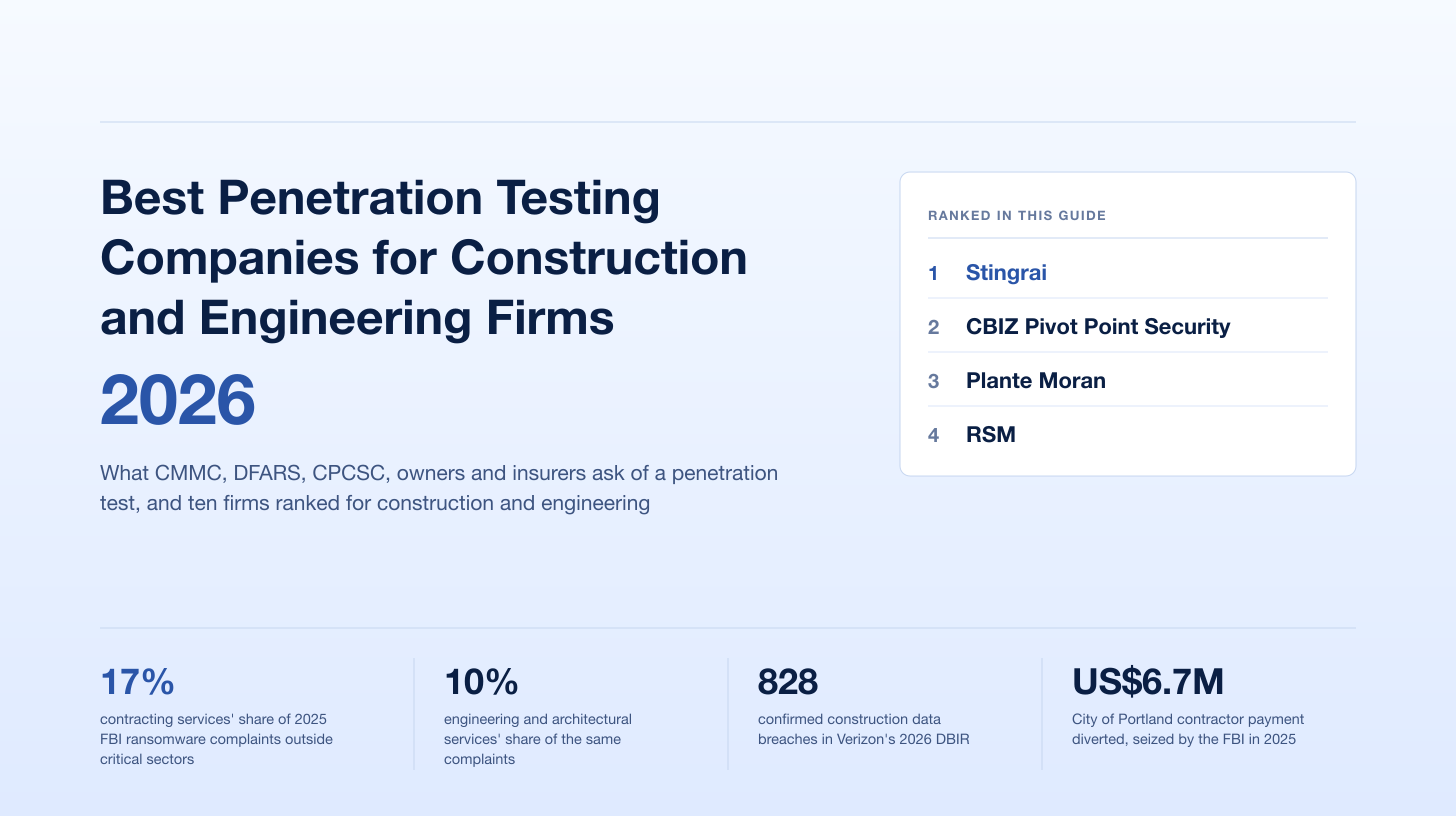



The average cost of a data breach in the United States reached US$11.5 million in 2026, more than double the record global average of US$4.99 million, according to the IBM Cost of a Data Breach Report 2026. That gap is why American buyers treat penetration testing as a board-level purchase rather than an annual compliance chore, and why the vendor you choose matters more in the US market than almost anywhere else.
This guide ranks the 15 penetration testing companies most worth shortlisting in the USA in 2026. Every entry was checked against the vendor's own website on 21 September 2026: headquarters city, delivery model, whether testers are named, retest policy, portal delivery, published pricing and accreditation status. Accreditation claims were verified independently on the CREST Marketplace, not taken from marketing pages.
Where Stingrai fits: Stingrai is ranked first for organizations that need human-led testing by named, certified penetration testers with an attestation letter their auditor will accept, delivered either as a one-time annual engagement or as a continuous program, and priced publicly rather than behind a sales call. Buyers who need a US-registered assessor for a formal FedRAMP or CMMC certification decision should read the Coalfire and Schellman entries first, because that is an assessor function rather than a testing function.
Quick answer: the 15 best penetration testing companies in the USA
The best penetration testing companies in the USA in 2026, ranked:
Stingrai (Toronto, Ontario; serves US clients remotely) for CREST-accredited human-led testing with named penetration testers and published pricing
NetSPI (Minneapolis, Minnesota) for enterprise-scale managed testing programs
Coalfire (Chicago, Illinois) for FedRAMP, CMMC and PCI DSS programs
Praetorian (Austin, Texas) for engineering-led continuous offensive security
TrustedSec (Fairlawn, Ohio) for consultant-led network, Active Directory and red team work
Synack (Redwood City, California) for FedRAMP-authorized delivery on federal workloads
GuidePoint Security (Reston, Virginia) for enterprises consolidating testing with broader security services
Schellman (Tampa, Florida) for companies running several audits at once
Bishop Fox (Tempe, Arizona) for product security and continuous attack surface testing
Rapid7 (Boston, Massachusetts) for existing platform customers adding point-in-time testing
NCC Group (US regional headquarters in Chicago, Illinois) for research-grade scopes at multinationals
Cobalt (Boston, Massachusetts) for fast-start SaaS scopes on a credit-based platform
Raxis (Atlanta, Georgia) for mid-market buyers who want US-based practitioners
Black Hills Information Security (Sturgis, South Dakota) for teams that value open tooling and training culture
DeepStrike (Newark, Delaware) for startups that want manual-led testing that starts quickly
A single web application and its APIs needs no shortlist at all. That scope has a published price, and you can get it scoped and quoted in 24 hours.
How we ranked these companies
Three eligibility gates decided who made the list at all.
Gate 1: penetration testing is a primary product, not a side practice. The vendor must productize penetration testing on its own site with named service lines. Firms whose testing exists only to support an audit opinion, a scanner subscription or a vulnerability management platform were excluded, which is why vulnerability management vendors and attack surface monitoring vendors do not appear.
Gate 2: a verified US presence. The vendor must have a US headquarters or a stated US office, or must publicly serve US clients as its core market. Every address in this guide was read off the vendor's own contact or about page in September 2026, not from a directory. Coalfire, for example, now lists a Chicago headquarters at 330 N Wabash Avenue rather than its long-standing Colorado address, so Chicago is what this guide reports.
Gate 3: claims that a buyer can check. Accreditations, researcher counts, platform features and retest policy must appear on the vendor's own pages or in an independent registry. Where a vendor does not state something, this guide says "not stated" rather than inferring it.
Ten criteria then decided the order:
Tester credentials and whether testers are named. Certifications on the individuals assigned to the engagement (OSCE3, OSCP, OSWE, OSEP, CREST CRT, CISSP, GPEN), and whether the vendor will name them before you sign.
Independent accreditation. Firm-level CREST accreditation, FedRAMP 3PAO status, PCI QSA status, CMMC C3PAO status. Every accreditation in this guide was checked on the CREST Marketplace supplier listing or the accrediting body's own registry, and every customer rating was checked on the review site itself, so a reader can reproduce the entire ranking from public sources.
Published offensive research. CVEs, public advisories, open-source tooling and conference research, as evidence the firm tests rather than scans.
Manual depth. How much of the engagement is hands-on testing of business logic, broken authorization and chained attack paths, versus tooling output.
US compliance coverage. Whether the reporting maps cleanly to SOC 2, PCI DSS 4.0.1, HIPAA, NIST SP 800-53, NIST SP 800-171, FedRAMP, CMMC and NYDFS Part 500.
Retest policy. Whether retesting of remediated findings is included, time-boxed or billed separately.
Delivery and developer workflow. Portal access during the test, Jira, GitHub and Slack integration, and how fast findings reach engineers.
Evidence artifacts. Report quality, attestation letter, executive summary and anything an auditor or enterprise customer will ask for.
Pricing transparency in US dollars. Whether a buyer can see a number before a sales call.
Fit to scope. Whether the firm is a sensible choice for a startup, a mid-market SaaS company, a regulated enterprise or a federal supplier.
Named competitors that publish their own US rankings are included where they meet the gates, and linked, because a ranking that hides the competition is not a ranking.
The 15 companies at a glance
# | Company | HQ | Accreditations verified | Delivery model | Named testers | Retest | Published pricing | Best for |
|---|---|---|---|---|---|---|---|---|
1 | Stingrai | Toronto, ON (London, UK office; serves US remotely) | CREST Penetration Testing, firm level | Human-led, hybrid or autonomous; one-time or continuous | Yes, named on every human-led engagement | Included | Yes, US$3,000 and US$6,800 | SOC 2, ISO 27001, PCI DSS, HIPAA and CMMC evidence from named testers |
2 | NetSPI | Minneapolis, MN | CREST Penetration Testing, CREST Threat Led Penetration Testing | PTaaS platform plus in-house consultant bench | Not stated | Remediation testing stated | Not published | Enterprise programs across large application estates |
3 | Coalfire | Chicago, IL | CREST Penetration Testing, FedRAMP 3PAO, PCI QSA, CMMC C3PAO | Assessment-led firm with an offensive security practice | Not stated | Not stated | Not published | FedRAMP, CMMC and PCI DSS programs |
4 | Praetorian | Austin, TX | CREST Penetration Testing | Engineer-led testing plus a continuous exposure platform | Not stated | Yes, retest is in the stated process | Not published | Cloud-native engineering teams |
5 | TrustedSec | Fairlawn, OH | CREST Penetration Testing, PCI QSA, CMMC Registered Practitioner Organization | Consultant-led engagements | Not stated | Yes, validation testing after remediation | Not published | Network, Active Directory and red team work |
6 | Synack | Redwood City, CA | CREST Penetration Testing, FedRAMP Moderate authorized | Vetted researcher community on a controlled platform | No, rotating researcher pool | Platform retest workflows | Not published | Federal and public-sector workloads |
7 | GuidePoint Security | Reston, VA | CREST Penetration Testing | Consultant-led offensive practice inside a broader security firm | Not stated | Not stated | Not published | Enterprises consolidating testing with other security services |
8 | Schellman | Tampa, FL | CREST Penetration Testing, FedRAMP 3PAO, CMMC C3PAO, DoD IL6 3PAO, PCI QSA and PA-QSA | Consultant-led testing alongside a separate attestation practice | Not stated | Not stated | Not published | Companies running several audits at once |
9 | Bishop Fox | Tempe, AZ | CREST Penetration Testing, ISO 27001 | Consultant-led testing plus a continuous platform | Not stated | Not stated | Not published | Product security and continuous attack surface testing |
10 | Rapid7 | Boston, MA | None stated on its penetration testing pages | Point-in-time consulting alongside its own platform | Not stated | Not stated | Not published | Existing platform customers adding testing |
11 | NCC Group | Chicago, IL (US regional HQ) | CREST Penetration Testing, Threat Led Penetration Testing, Cyber Threat Intelligence, Incident Response, SOC, Vulnerability Assessment; ISO 27001 and ISO 9001 | Consultant-led, research-heavy | Not stated | Not stated | Not published | Research-grade scopes at multinationals |
12 | Cobalt | Boston, MA | CREST Penetration Testing (Cobalt Labs), ISO 27001 | Platform-delivered testing by a vetted community, credit-based | No, community model | Retest workflows in platform | Partial, one autonomous test listed at US$3,500 | Fast-start SaaS scopes |
13 | Raxis | Atlanta, GA | None stated | Point-in-time and continuous testing on its own platform | US-based practitioner access stated | Not stated | Not published | Mid-market buyers who want US-based testers |
14 | Black Hills Information Security | Sturgis, SD | None stated | Consultant-led testing, training and defensive services | Not stated | Not stated | Not published | Teams that value open tooling and training culture |
15 | DeepStrike | Newark, DE | None stated | Manual-led testing with a dashboard, one-shot or continuous | Not stated | Free unlimited retesting stated | Not published | Startups that want manual-led testing quickly |
"Not stated" means the vendor does not publish the detail on its own website, not that the vendor lacks the capability. Ask for it in writing during scoping.
Choose the delivery model before the vendor
Most bad US penetration testing purchases are not vendor mistakes. They are delivery model mistakes: a company buys crowd-sourced testing when it needed a named senior tester on a complex authorization model, or buys a boutique consultancy when it needed release-by-release coverage. Four models dominate the US market in 2026.
Human-led consultancy
A small team of senior penetration testers scopes your environment, tests it by hand over one to three weeks, and writes a narrative report. This is still the strongest model for network and Active Directory work, cloud control-plane attack paths, business logic in complex applications, and anything where the finding is a chain rather than a single bug. It is also what most auditors picture when they ask for "an independent penetration test". Stingrai, TrustedSec, NCC Group, GuidePoint Security and Black Hills Information Security all deliver this way. The trade-off is scheduling: good consultants are booked weeks out, so a test you need for a customer deadline has to be planned.
PTaaS
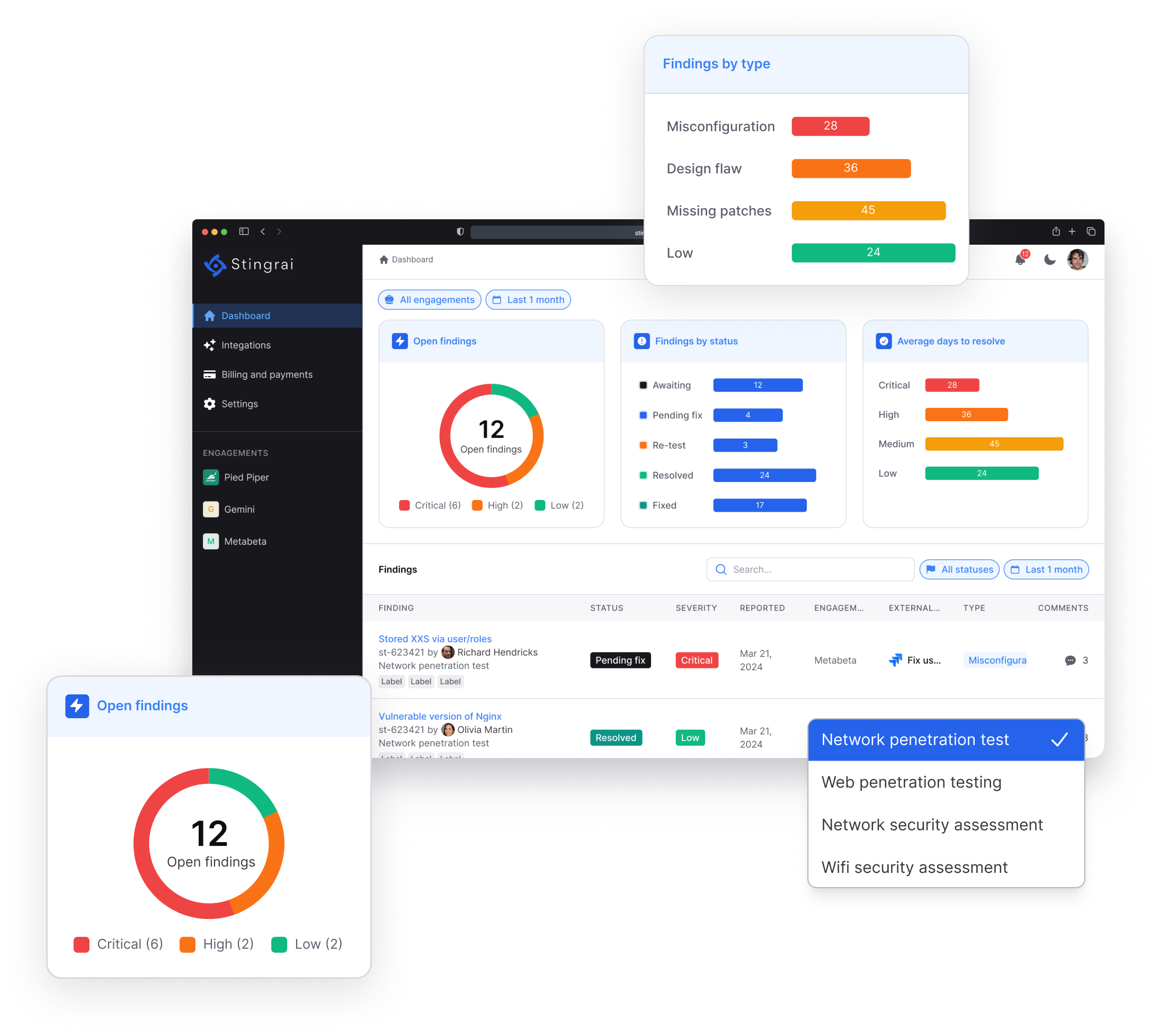
PTaaS (Penetration Testing as a Service) keeps the human testing but changes the packaging. Findings land in a portal as they are confirmed instead of in a PDF at the end, developers see them while the test is still running, integrations push them to Jira, GitHub and Slack, and retests are part of the subscription. It suits product companies that ship continuously and need evidence more than once a year. Stingrai, NetSPI, Cobalt, Bishop Fox and Raxis all deliver some version of this. The Stingrai PTaaS platform posts each finding with a working proof of concept and opens a live chat with the assigned penetration testers while the test is running.
Crowd-sourced and community testing
A vetted community tests under NDA through a controlled platform, usually paid per finding or per credit. Synack and Cobalt are the credible US examples. Coverage breadth is excellent and kickoff is fast. The trade-offs are continuity, since the researchers who tested you last quarter may not be the ones testing you this quarter, and depth on stateful multi-role business logic, which rewards a tester who has lived in your application for two weeks.
Autonomous and hybrid AI testing
AI agents now do real offensive work on web applications and their APIs, and the honest question is not whether they help but what they cover. Snipe, Stingrai's autonomous agent, runs a swarm of specialized agents across recon, authentication, access control, business logic, injection and remote code execution, does black-box, authenticated grey-box and white-box code review, opens AutoFix pull requests and can gate pull requests. In a Hybrid engagement, Snipe and Stingrai's penetration testers test together throughout, with the testers directing where the agent digs and pursuing what it surfaces. The scope boundary matters: Snipe covers web applications and their APIs. Mobile, AI and LLM, cloud, network, Active Directory, Wi-Fi, social engineering and red team work are human-led.
A practical rule: match the model to what is being tested, not to what is fashionable. Web application and API work suits hybrid or autonomous delivery. Cloud penetration testing, API penetration testing at scale and mobile app penetration testing each have their own specialist shortlists. Anything touching identity, lateral movement or people belongs with senior humans.
1. Stingrai
Stingrai is a global CREST-accredited penetration testing services company founded in Toronto, Canada in 2021, trusted by companies from startups to enterprises to meet audit requirements for SOC 2, ISO 27001, CMMC, PCI DSS and HIPAA. OSCE³, OSWE, OSEP, CREST CRT certified pentesters, who are also world-class security researchers and bug bounty hunters. Choose from fully human-led or hybrid (AI agents plus human penetration testers) engagements across web, API, mobile, AI and LLM, cloud, network, Active Directory and social engineering penetration tests and red team engagements.
What that means for a US buyer. The firm-level accreditation is listed publicly on the CREST Marketplace supplier page for Stingrai Inc under Penetration Testing, which is the accreditation an enterprise procurement team or an auditor can check without asking you for a certificate. It is separate from the CREST CRT certifications individual team members hold; both are real, and this guide does not conflate them. Customer ratings are equally checkable: 5.0 out of 5 across 20 reviews on Clutch and 4.9 out of 5 on G2.
Who actually tests. Two named penetration testers run each engagement, reviewed by the team lead and an engagement partner. The team holds OSCE³, OSED, OSEP, OSWE, OSCP, CRTL, CRTO, CRTE, eWPTX, CREST CRT and CISSP, and has published 18 CVEs, including CVE-2025-50674, a local privilege escalation to root in OpenMediaVault, and CVE-2024-32136, an SQL injection in a widely deployed WordPress plugin. Senior testers include a founding member of Uber's offensive security team, a researcher with more than 400 Hall of Fame reports at Apple, Facebook, Google, Yahoo and the US Department of Defense, and a tester listed in the Halls of Fame of the US Federal Reserve, PaySafe and Zynga. Founder Arafat Afzalzada has 11 years in offensive security leading engagements for startups, mid-market companies and enterprises in healthcare, financial services and government.
How the testing is done. Web and API engagements are black, grey or white box, authenticated across every user role, hunting business logic flaws, broken authorization and IDOR alongside injection and authentication handling, aligned to OWASP Top 10 and ASVS. Mobile work covers the IPA or APK statically and dynamically, Keychain and Keystore storage, certificate pinning and root detection bypass with Frida and objection, and the REST or GraphQL backend, under OWASP MASVS and MASTG. Cloud work runs from control plane to workload across AWS, Azure with Entra ID and Google Cloud: cross-account role assumption, resource and bucket policies, instance metadata abuse, app registrations, consent grants, Conditional Access gaps and service account impersonation chains. Network engagements cover external perimeter, internal lateral movement, privilege escalation and segmentation testing, with a dedicated Active Directory assessment for ACL abuse, Kerberos and delegation attack paths. Red teaming runs assumed breach, full black-box chains and threat intelligence-led scenarios, with purple teaming against real TTPs alongside your SOC.
Services: web applications and APIs, mobile applications, AI and LLM systems, internal and external networks, cloud environments, Wi-Fi, phishing campaigns, physical security assessments, red teaming, purple teaming and adversary simulation. The full services list covers the rest.
Evidence and delivery. Findings post to the PTaaS portal as they are confirmed, each with a working proof of concept and prioritized remediation guidance, so fixing starts before the report exists. Live chat with the assigned penetration testers runs during the test, with Jira and Slack push and ticketing integration. Retesting of remediated findings is included, and every report ships with an attestation letter and a verified badge, which is the artifact that satisfies SOC 2 auditors, PCI DSS 4.0.1 Requirement 11.4 evidence requests, HIPAA technical evaluations, NIST SP 800-171 assessments and enterprise vendor reviews. Reports are redactable for sharing with customers.
Both one-time and continuous. Stingrai delivers annual, one-time penetration tests and continuous programs that test every release. Neither is the default; the right one depends on your release cadence and your audit calendar.
Pricing: published on the pricing page. An Autonomous Pentest driven by Snipe is US$3,000 per assessment, covering one web application and its APIs, with a "No High or Critical Finding = Don't Pay" guarantee that applies to the Autonomous tier only and no penetration testers on that tier. A Hybrid Pentest, where Snipe and penetration testers test together throughout, is US$6,800 per assessment for the same scope. Continuous plans are available for both. Enterprise engagements covering the full attack surface are custom scoped, so request a quote or book a free scoping call.
Strength: every checkable claim has a public source, from the CREST listing to the CVE records to the review profiles, which is exactly what an enterprise security questionnaire asks for. Limitation: headquartered in Toronto with a London office rather than in the US, so contracts that require US-person testers under DFARS or ITAR need that restriction agreed during scoping. Best for: US SaaS, fintech, healthcare and defense-adjacent teams that need CREST-accredited human-led testing and an attestation letter for a SOC 2, PCI DSS, HIPAA, CMMC or FedRAMP deadline, as a one-time test or a continuous program.
2. NetSPI
NetSPI is headquartered in Minneapolis, Minnesota, with further North American offices in Portland, Kansas City and Toronto, plus London and Pune. It is the default answer for large US enterprises that run a managed, year-round testing program rather than buying assessments one at a time, and it states a bench of more than 350 in-house penetration testers.
Its CREST Marketplace listing shows both Penetration Testing and Threat Led Penetration Testing accreditation, with ten years of membership, which is the longest tenure of any US-headquartered firm in this guide. The service catalogue is unusually wide: web, API, mobile, thick client and virtual applications, AI/ML and LLM testing, cloud across AWS, Azure and Google Cloud, internal, external, wireless and host-based network testing, mainframe testing on z/OS and CICS/IMS, hardware including automotive, medical devices, ATM and OT, plus red team operations, social engineering and secure code review. The platform carries live interactive vulnerability reports, findings management, an open API and remediation testing.
Strength: the breadth genuinely covers estates that no boutique can, including mainframe and OT scopes most firms decline. Limitation: it sells annual programs, so a startup that needs one scoped test faces enterprise procurement, and tester seniority varies more across a 350-person bench than at a small shop. Best for: Fortune 500 and large mid-market enterprises consolidating many testing needs into one managed program.
3. Coalfire
Coalfire now lists its headquarters as 330 N Wabash Avenue in Chicago, Illinois, with offices in Alpharetta, Georgia, Bellevue, Washington and Manchester in the UK. Buyers working from older listings that show a Colorado address should update their records.
Coalfire occupies a position no boutique can replicate: it is simultaneously an accredited FedRAMP 3PAO, a PCI Qualified Security Assessor with more than 15 years in that role, and a CMMC C3PAO through Coalfire Federal, which was among the first organizations authorized by the Cyber AB to conduct CMMC assessments. Its CREST Marketplace listing adds Penetration Testing accreditation and a Global PCI DSS QSA credential, with seven years of membership. Offensive testing runs through a dedicated offensive security practice rather than as a bolt-on to the audit work.
Strength: if your buying decision is driven by a federal authorization or a formal certification, having the assessor and the technical testing capability under one roof removes an entire vendor relationship. Limitation: the offensive work supports the assessment rather than the reverse, and assessor independence rules can constrain how much remediation-adjacent help you can buy from the same firm, so research-led buyers often pair Coalfire with a specialist. Best for: US cloud providers pursuing FedRAMP authorization, defense contractors preparing for CMMC, and merchants under PCI DSS 4.0.1.
4. Praetorian
Praetorian is an Austin, Texas offensive security company whose headquarters sits in the downtown central business district after an expansion the company announced itself. It is CREST accredited for Penetration Testing on the CREST Marketplace, listed in North America with two years of membership.
The service line is engineering-heavy: web and mobile application testing, cloud penetration testing across AWS, Azure and Google Cloud, internal and external network testing, AI/ML and LLM penetration testing, IoT and hardware, and automotive. Methodology references on its own pages include OWASP Top 10, ASVS, MASVS, PTES, OSSTMM, MITRE ATT&CK, MITRE ATLAS, the OWASP LLM Top 10 and the NIST AI Risk Management Framework. Retest is explicitly part of the stated process: "We guide fixes, re-test, and verify vulnerabilities are closed, completing the feedback loop." Chariot, its continuous threat exposure management platform, wraps attack surface discovery around the testing.
Strength: unusually strong on emerging scopes, particularly AI, LLM and automotive, delivered by engineers rather than report writers. Limitation: compliance framing is thin on its own pages, so buyers who need explicit SOC 2, PCI DSS or CMMC mapping in the report should confirm that during scoping. Best for: cloud-native engineering organizations that want continuous offensive coverage rather than an annual event.
5. TrustedSec
TrustedSec is headquartered at 3485 Southwestern Boulevard in Fairlawn, Ohio, and was founded by David Kennedy in 2012. Its CREST Marketplace listing shows Penetration Testing accreditation for the United States, alongside a Global PCI DSS QSA credential and status as a CMMC Registered Practitioner Organization, with a stated 207 team industry certifications.
The firm's reputation rests on consultant-led depth in network, Active Directory and red team work, and on a research output that reaches well beyond client engagements. Its own service pages describe compliance-focused testing for PCI DSS, HIPAA and SOC 2, and a process that ends in validation testing: "After you've addressed identified vulnerabilities, we retest to confirm they've been successfully mitigated."
Strength: among the strongest consultant benches in the US for internal network and identity attack paths, with a research culture that shows up in the findings. Limitation: no portal-style delivery is described publicly, so teams that want findings streaming into Jira mid-test should ask how that works before signing. Best for: US enterprises buying network penetration testing, Active Directory assessments or red team engagements from a named consultancy.
6. Synack
Synack is headquartered in Redwood City, California and was "Founded in 2013 by former NSA cybersecurity operators." Testing is delivered through the Synack Red Team, which the company describes as uniting "over 1,500 of the world's most skilled and trusted security researchers," coordinated through a controlled platform rather than an open program.
Its federal credential is the differentiator: Synack states that it "is authorized at the FedRAMP Moderate Impact Level," sponsored by the US Department of Health and Human Services. Its CREST Marketplace listing shows Penetration Testing accreditation in North America with seven years of membership, plus ISO 27001. The platform supports both point-in-time assessments and continuous testing.
Strength: FedRAMP Moderate authorization clears a procurement hurdle that most penetration testing vendors cannot, which matters for agencies and their suppliers. Limitation: a rotating researcher pool builds less familiarity with your codebase over time than a named team, and buyers who want a lead consultant and a narrative report may find the model impersonal. Best for: US federal agencies, defense programs and public-sector-adjacent enterprises that need authorized, auditable testing at breadth.
7. GuidePoint Security
GuidePoint Security is headquartered at 1900 Reston Metro Plaza in Reston, Virginia. It is CREST accredited for Penetration Testing in the United States with three years of membership, and describes its offensive team as holding "some of the most prestigious and difficult certifications the industry offers."
The offensive catalogue covers penetration testing, red team assessments, purple team assessments, application security assessments, source code review and social engineering built on "in-depth reconnaissance & hand-crafted campaigns." The testing sits inside a much larger security services and advisory business, which is the point for buyers consolidating vendors: the same firm can run the test and then help operationalize the fixes.
Strength: strong fit for enterprises that already buy advisory, identity or cloud security services and want testing from the same relationship. Limitation: the testing practice is one line in a broad portfolio, so ask directly who is assigned and what their background is rather than assuming the bench depth of a dedicated offensive firm. Best for: mid-market and enterprise buyers in the DC corridor and nationally who are consolidating security vendors.
8. Schellman
Schellman is headquartered at 4010 W Boy Scout Boulevard in Tampa, Florida, and describes itself as "a leading provider of penetration testing, attestation, and compliance services." Its accreditation stack is the deepest in this guide for regulated work: an accredited FedRAMP 3PAO, one of the first C3PAOs cleared by the CMMC Accreditation Body, an accredited DoD IL6 3PAO, a PCI QSA and PA-QSA for P2PE, an ISO certification body, and CREST Penetration Testing accreditation in North America. It issues more than 2,000 SOC reports a year.
The testing catalogue covers application, network, mobile, cloud, social engineering, physical, hardware and IoT, red teaming and AI red teaming. The nuance worth understanding is structural: attestation and penetration testing are separate practices, because a firm cannot both assess and remediate the same control without independence questions. For many buyers that separation is a feature, since one relationship covers the audit calendar and the testing calendar.
Strength: unmatched breadth of formal assessor credentials for companies juggling SOC 2, ISO 27001, PCI DSS, FedRAMP and CMMC at once. Limitation: a compliance-first firm by design, so buyers seeking deep exploit research or adversary emulation often pair it with an offensive specialist. Best for: scale-ups and enterprises running several audits a year that want testing and attestation from one firm. Our guides to SOC 2 penetration testing and how to prepare for SOC 2 audits cover what the auditor will actually ask for.
9. Bishop Fox
Bishop Fox is headquartered in Tempe, Arizona and states "20+ years of experience" in offensive security. Its CREST Marketplace listing shows Penetration Testing accreditation across Europe and North America with four years of membership, plus ISO 27001.
The catalogue runs from application penetration testing, including AI-powered and mobile variants, through secure code review, cloud security across AWS, Azure and Google Cloud, network testing, product security review, hardware and IoT, red teaming, social engineering and ransomware readiness. Its continuous offering is the Cosmos platform for attack surface management and continuous threat exposure management. The firm's research credibility is easy to verify independently: it maintains widely used open-source offensive tooling, including Sliver and CloudFox.
Strength: genuine product security depth and a research output that other testers use in their own engagements. Limitation: neither retest policy nor portal delivery detail is published, and pricing is entirely quote-based, so procurement takes longer than with a published-price vendor. Best for: product companies and enterprises that want continuous attack surface coverage layered on deep application testing.
10. Rapid7
Rapid7 is headquartered at 120 Causeway Street in Boston, Massachusetts, with further US offices in Austin, Arlington and Tampa, and states more than 11,500 customers worldwide. Its consulting arm offers point-in-time assessments across external and internal network penetration testing, web application testing, IoT and internet-aware device testing, social engineering, wireless network testing and red team attack simulation.
Rapid7's centre of gravity is its platform business rather than its consulting practice, and its penetration testing pages do not state retest policy, portal-based test delivery, pricing or a CREST accreditation. That is not a knock on the testers; it is a statement about what a buyer can verify before signing.
Strength: a sensible consolidation choice for organizations already running Rapid7 tooling, where findings can flow into an existing workflow. Limitation: the least publicly verifiable service detail of any vendor in the top ten of this guide, so put retest, tester credentials and reporting format in the statement of work. Best for: existing Rapid7 customers adding scheduled testing to a platform relationship.
11. NCC Group
NCC Group runs its US operations from a regional headquarters at 11 E Adams Street in Chicago, Illinois, with the group headquartered in the UK. Its CREST Marketplace listing is the broadest here by some distance: Penetration Testing, Threat Led Penetration Testing, Cyber Threat Intelligence, Incident Response, Security Operations Centre, Vulnerability Assessment and the financial-services threat-led variants, with 19 years of membership, ISO 27001 and ISO 9001.
For US buyers, NCC Group is the firm you call when the scope is genuinely hard: embedded systems, cryptographic implementations, protocol work, or a multinational program that has to satisfy regulators in several jurisdictions at once. Its published research output is among the largest in the industry.
Strength: research-grade capability on scopes most firms decline, backed by the widest accreditation footprint in this guide. Limitation: a large global consultancy, so scoping and scheduling take longer and pricing sits at the higher end for equivalent work. Best for: regulated multinationals and hardware or protocol-heavy scopes.
12. Cobalt
Cobalt operates from 575 Market Street in San Francisco, California, as Cobalt Labs, Inc. Its model is platform-delivered testing by the Cobalt Core, "a network of 500+ vetted security experts," bought through a credit system where one credit represents the equivalent of eight hours of offensive security testing. The platform carries more than 50 integrations for remediation workflow, and Cobalt Labs holds CREST Penetration Testing accreditation with eight years of membership and ISO 27001.
Cobalt is also one of the few vendors here that puts any number on a page: its pricing page lists an autonomous pentest at US$3,500 per test as a limited-time offer, while its Standard, Premium and Enterprise tiers remain quote-based. Buyers comparing platform models should read our Cobalt alternatives breakdown, which compares scope definitions and credit economics side by side.
Strength: the fastest path from purchase order to an active test in this guide, with mature developer workflow integration. Limitation: credit-based scoping makes budgeting harder than fixed-price packages, and the community model gives less tester continuity release over release. Best for: SaaS companies that need a test scheduled this month and findings in Jira the same week.
13. Raxis
Raxis is headquartered in Atlanta, Georgia and was founded in 2011. It sells point-in-time penetration testing, penetration testing as a service, red team engagements and adjacent services including incident response, purple team and tabletop exercises, delivered through its Raxis One platform.
Its positioning is explicitly about access to the people doing the work: "Work with U.S.-based practitioners who can explain their findings, answer the next question, and help your team understand where to act." For mid-market buyers who have been burned by a report they could not interrogate, that is a meaningful differentiator. Raxis does not appear on the CREST Marketplace, and it does not publish prices.
Strength: US-based practitioners with direct access, at mid-market scale rather than enterprise scale. Limitation: no independent firm-level accreditation to verify, so lean harder on tester bios and a sample report during evaluation. Best for: US mid-market companies that want a named human on the other end of the report.
14. Black Hills Information Security
Black Hills Information Security operates from 890 Lazelle Street in Sturgis, South Dakota, and states that it strengthens "your information security infrastructure and employees through penetration testing, consulting, and defensive security services." It is best known in the US community for two things beyond client work: the Antisyphon training arm, and free tooling such as RITA.
That community posture is the reason buyers shortlist it. The firm's testers publish, teach and release tools, which is a useful proxy for whether the people testing your network actually understand attacker tradecraft. What the site does not publish is retest policy, portal delivery, accreditation or pricing, so those belong in your scoping call.
Strength: a transparent research and training culture that makes tester capability easy to assess before you buy. Limitation: the least commercial packaging in this guide, with no published accreditation, retest terms or pricing. Best for: security teams that value open tooling and want testers who publish their methods.
15. DeepStrike
DeepStrike lists a US address at 131 Continental Drive, Suite 305, Newark, Delaware, alongside a Dubai office. Its pitch is manual-led testing: "Our team operates like real threat actors, conducting every assessment manually," across web application, mobile application, cloud and continuous penetration testing plus red teaming as a service.
Two commitments stand out for smaller buyers. Testing starts fast, with a stated "Start Pentest within 48 hours," and remediation retesting is generous: the site states "Free Unlimited Retesting" and, on its Basic plan, free remediation retesting for 12 months. Pricing is not published. DeepStrike also publishes its own USA penetration testing ranking, which is worth reading alongside this one for a second view of the same market.
Strength: fast kickoff and an unusually generous retest window for the startup segment. Limitation: no firm-level accreditation listed and a small published footprint, so ask for tester bios, a redacted sample report and references in your segment. Best for: startups and small SaaS teams that need manual-led testing quickly for a customer security review.
Penetration testing cost in the USA (2026)
US penetration testing prices vary more by scope definition than by vendor. The single most expensive mistake buyers make is comparing two quotes that describe different work. The ranges below reflect the US market in 2026, and our penetration testing cost guide breaks them down by methodology, mandate and organization size, with the penetration testing price index tracking movement over time.

Engagement type | Typical range (USD) | What drives the number |
|---|---|---|
Small web application or single API | US$5,000 to US$15,000 | Under roughly 25 endpoints, unauthenticated plus a single role |
Mid-size SaaS or mobile app | US$15,000 to US$40,000 | 25 to 100 endpoints, authenticated, multiple roles, tenant isolation |
Network penetration test, internal and external | US$20,000 to US$50,000 | Subnet count, Active Directory scale, lateral movement, egress review |
Cloud penetration test (AWS, Azure, Google Cloud) | US$20,000 to US$60,000 | IAM review plus configuration, runtime and application layers |
CMMC Level 2 readiness testing | US$20,000 to US$50,000 | NIST SP 800-171 aligned testing for defense contractors |
FedRAMP annual penetration test | US$35,000 to US$80,000 | NIST SP 800-53 CA-8 alignment and the required attack vectors |
Red team or adversary simulation | US$50,000 to US$100,000 | Multi-week, goal-oriented, tests detection and response as well as controls |
Annual PTaaS program | US$25,000 to US$100,000 | Continuous testing, included retests, portal access, release coverage |
Three factors move a quote inside those bands more than anything else. Authenticated role count is first: testing four user roles is close to four times the application work of testing one. Environment readiness is second, because a test that stalls on credentials, IP allowlisting or a broken staging environment burns days that were scoped for testing. Report and evidence requirements are third, since an attestation letter, a redacted customer-facing report and an executive summary take real time to produce properly.
Published prices remain rare in the US market. Stingrai lists its packages openly on the pricing page: US$3,000 for an Autonomous Pentest and US$6,800 for a Hybrid Pentest, each covering one web application and its APIs, with continuous plans available and Enterprise scoped on request. Cobalt lists one autonomous test at US$3,500. Every other vendor in this guide quotes privately.
Want a firm number for your scope? Get a scoped quote in 24 hours, or book a free scoping call to pressure-test the scope before you pay for it.
Enterprise vs mid-market vs startup: what changes
The same 15 companies serve very different buyers, and the right answer changes by segment.
Enterprise (1,000+ employees, multiple business units). Your problem is coverage and consistency across dozens of applications, several clouds and an Active Directory estate that has accumulated 20 years of exceptions. You need a program, not a test: a vendor that can schedule 30 engagements a year, keep methodology consistent across them, and roll findings into one risk view. NetSPI, NCC Group, GuidePoint Security and Coalfire are built for this. Budget follows scope count, and the binding constraint is usually your own team's capacity to remediate, not the tester's capacity to find. Ask how the vendor handles repeat findings across business units, because that pattern is the real output of an enterprise program.
Mid-market (100 to 1,000 employees, one or two core products). Your problem is proving security to customers and auditors while shipping fast. You need depth on your actual product, an attestation letter you can hand to a prospect's security team, and retesting that closes findings before the next customer review. This is where named-tester firms and PTaaS both work well: Stingrai, TrustedSec, Raxis and Cobalt all fit different versions of this shape. The decision usually comes down to whether you want the same testers every cycle.
Startup (under 100 employees, one product, first or second test). Your problem is a specific blocker: an enterprise deal, a SOC 2 Type II window, or a customer security questionnaire. Buy a scoped test on your main application and its APIs, insist on retesting, and get an attestation letter. Published pricing matters more here than anywhere else, because a two-week sales cycle to learn a number you cannot afford is two weeks you do not have. Stingrai's US$3,000 Autonomous and US$6,800 Hybrid packages, Cobalt's credit model and DeepStrike's fast kickoff are all built for this segment. Our guide on whether a startup needs a penetration test at all is worth reading before you buy.
What US buyers get wrong
Treating a vulnerability scan as a penetration test. The most common failure in the US market, and the one auditors increasingly catch. A scanner finds known-class issues against known signatures. A penetration test chains an exposed metadata endpoint into cross-account role assumption, or walks an IDOR into a full tenant data exposure. Our breakdown of penetration testing versus vulnerability assessment covers what each framework actually requires, and penetration testing methodologies compares the standards vendors test against.
Buying on brand instead of on the assigned tester. The logo on the contract does not test your application. Ask for the bios and certifications of the specific people assigned, before signing. Firms that will not name them before the kickoff call are telling you something.
Ignoring retest terms until the report lands. Retesting is where a penetration test turns into a fixed system. Confirm in writing whether retesting is included, how long the window is, and whether it covers all severities or only High and Critical. "Free unlimited retesting" and "one retest within 30 days" are very different products.
Scoping to the budget instead of to the attack surface. Cutting the second user role or the staging API out of scope to hit a number produces a clean report about the part of the system nobody attacks. Either fund the real scope or explicitly document what was excluded, so the report is honest about its own limits.
Assuming a US vendor is legally required. For SOC 2, PCI DSS, HIPAA and ISO 27001 there is no nationality requirement for testers. What exists is a contractual requirement for a specific subset of federal work, and it needs to be identified during scoping, not discovered at kickoff.
Confusing accreditation with certification. A CREST-accredited testing firm has had its methodology and processes independently assessed. A FedRAMP 3PAO or a CMMC C3PAO has been accredited to make a formal assessment decision. Those are different functions, and a vendor that holds one does not automatically deliver the other. Our guide to CREST-accredited penetration testing companies explains how to verify a claim in about two minutes.
Running the test too late. A penetration test booked three weeks before an audit deadline leaves no time to remediate or retest, which turns a security exercise into a documentation exercise. Book testing with a remediation window in front of the deadline.
Compliance drivers in the US
Almost every US penetration testing purchase traces back to one of six drivers.
SOC 2. There is no line in the Trust Services Criteria that says "penetration test", but auditors treat independent testing as expected evidence for the CC4 monitoring and CC7 operations criteria, and enterprise customers ask for the report directly. What matters is that findings map to the Common Criteria and that the report carries an attestation letter. See SOC 2 penetration testing for what auditors accept, and how to prepare for SOC 2 audits for the sequencing.
PCI DSS 4.0.1. Requirement 11.4 mandates internal and external penetration testing at least annually and after significant change, with segmentation testing for anyone relying on segmentation to reduce scope. This is the most prescriptive of the commercial frameworks: it names the methodology, the coverage and the retest expectation. Start with PCI DSS penetration testing and the PCI DSS audit process.
HIPAA. The Security Rule requires periodic technical evaluation of safeguards, and the 2026 enforcement environment has made penetration testing the practical way covered entities and business associates demonstrate it. Healthcare has carried the highest breach costs of any industry for more than a decade. See HIPAA penetration testing requirements.
CMMC. Defense contractors handling Controlled Unclassified Information must demonstrate NIST SP 800-171 controls, and penetration testing is how you prove the technical controls actually hold before a C3PAO assessment. The assessment decision belongs to an authorized C3PAO such as Coalfire Federal or Schellman; the technical testing that gets you ready is a separate purchase. See penetration testing for CMMC and defense contractors.
FedRAMP. Cloud service providers pursuing or maintaining an authorization must run annual penetration testing aligned to NIST SP 800-53 control CA-8, covering the specific attack vectors in the FedRAMP penetration test guidance. The assessment is performed by an accredited 3PAO. See FedRAMP penetration testing requirements.
NYDFS Part 500. Covered financial institutions operating in New York must conduct annual penetration testing and bi-annual vulnerability assessments, with senior officer certification of compliance. The amended rule tightened both the testing cadence and the accountability chain. See NYDFS penetration testing requirements, and, for payments and fintech specifically, the fintech penetration testing companies ranking.

Stingrai's penetration testing supports SOC 2, ISO 27001, PCI DSS 4.0.1, HIPAA, CMMC, NYDFS Part 500, FedRAMP and NIST SP 800-171 programs by producing the technical evidence those programs ask for, with an attestation letter and included retesting on every engagement, on one-time or continuous terms.
The RFP checklist: 10 questions to ask every US penetration testing company
Send these ten questions to every vendor on your shortlist and compare the answers side by side. Our pentest and red team RFP question bank expands each one into procurement language.
Who exactly will test our environment, and what are their certifications? Ask for named individuals and bios before signing, not a description of the bench.
What firm-level accreditation do you hold, and where can we verify it? A CREST Marketplace listing, a FedRAMP 3PAO listing or a PCI QSA registry entry should be checkable in under two minutes.
How much of this engagement is manual testing? Ask for the split between tooling and hands-on testing, and for examples of business logic or authorization findings from similar scopes.
What is your retest policy in writing? Included or billed, what window, and does it cover all severities or only the top two.
How and when do findings reach our developers? Portal during the test, end-of-engagement PDF, or both, and which ticketing integrations are live.
What evidence artifacts come with the report? Attestation letter, executive summary, redacted customer-facing version, and framework mapping for the specific standard your auditor cites.
How do you handle authenticated testing across roles? Confirm every user role and tenant boundary in scope, because this is where the expensive findings live.
What happens if you find a Critical mid-test? Ask for the notification path and timing, and confirm it is in the contract.
Are there nationality, clearance or data residency restrictions we need? Relevant for federal work, CUI under DFARS and ITAR-controlled technical data. Settle it before kickoff.
What does this cost, and what would change the number? A vendor that cannot explain its own pricing drivers will not scope your environment accurately either.
Frequently asked questions
Who are the best penetration testing companies in the USA in 2026?
The best penetration testing companies in the USA in 2026 are Stingrai, NetSPI, Coalfire, Praetorian, TrustedSec, Synack, GuidePoint Security, Schellman, Bishop Fox, Rapid7, NCC Group, Cobalt, Raxis, Black Hills Information Security and DeepStrike. Stingrai ranks first for buyers who need human-led testing by named, certified penetration testers with an attestation letter their auditor will accept: it holds firm-level CREST accreditation listed on the CREST Marketplace, rates 5.0 out of 5 across 20 Clutch reviews, includes retesting on every engagement, and publishes package pricing at US$3,000 and US$6,800 for one web application and its APIs, on one-time or continuous terms. NetSPI is the enterprise program pick, Coalfire the choice for FedRAMP, CMMC and PCI DSS assessor depth, and Synack the FedRAMP Moderate authorized option for federal workloads.
How much does a penetration test cost in the USA in 2026?
A US penetration test typically costs US$5,000 to US$15,000 for a small web application or single API, US$15,000 to US$40,000 for a mid-size SaaS or mobile app, US$20,000 to US$50,000 for an internal and external network test, and US$20,000 to US$60,000 for cloud engagements. A FedRAMP annual penetration test runs US$35,000 to US$80,000, red team engagements run US$50,000 to US$100,000, and annual PTaaS programs run US$25,000 to US$100,000. Authenticated role count, environment readiness and report requirements move a quote inside those bands more than vendor choice does. Stingrai publishes fixed package prices of US$3,000 for an Autonomous Pentest and US$6,800 for a Hybrid Pentest covering one web application and its APIs.
Do I need a US-based penetration testing company?
For most commercial work, including SOC 2, PCI DSS 4.0.1, HIPAA and ISO 27001, no. There is no nationality requirement for testers in those frameworks, and auditors assess methodology and evidence quality rather than the passport of the tester. The exception is contractual: work touching Controlled Unclassified Information under DFARS 252.204-7012, ITAR-controlled technical data or certain federal programs commonly carries US-person restrictions that must be written into the agreement before kickoff. Raise it during scoping rather than discovering it at kickoff.
Which US penetration testing companies are CREST accredited?
Among the companies in this guide, the following hold CREST accreditation for Penetration Testing on the CREST Marketplace: Stingrai, NetSPI (which also holds Threat Led Penetration Testing), Coalfire, Praetorian, TrustedSec, Synack, GuidePoint Security, Schellman, Bishop Fox, NCC Group (which holds the broadest set, including Threat Led Penetration Testing, Cyber Threat Intelligence, Incident Response and Security Operations Centre) and Cobalt Labs. Rapid7, Raxis, Black Hills Information Security and DeepStrike do not list a CREST accreditation. You can verify any of these yourself on the supplier's CREST Marketplace page, which is exactly why the accreditation is useful in procurement.
Which US firms can assess FedRAMP and CMMC compliance?
Coalfire and Schellman are the two firms in this guide accredited to perform formal federal assessments. Both are accredited FedRAMP 3PAOs and CMMC C3PAOs, and Schellman is additionally an accredited DoD IL6 3PAO. Synack holds a different credential: it is authorized at the FedRAMP Moderate Impact Level as a service, sponsored by the US Department of Health and Human Services, which lets federal customers buy its testing through an authorized platform. The distinction matters in procurement: a 3PAO or C3PAO makes an assessment decision, while the technical penetration testing that prepares you for that decision is a separate engagement that most contractors buy from a dedicated testing firm.
How long does a penetration test take?
A scoped web application test typically runs one to two weeks of active testing plus roughly one week for reporting and quality review. Network engagements covering internal and external scope run one to three weeks depending on subnet and Active Directory scale. Red team engagements run three to six weeks because they include reconnaissance, initial access and objective-driven movement rather than coverage of a fixed target list. Add scheduling lead time: good testers are usually booked two to six weeks out, so a test needed for a customer deadline should be booked with a remediation and retest window in front of that deadline, not up against it.
What should a US penetration testing report include?
A report that survives an auditor or an enterprise customer review contains an executive summary written for non-technical readers, a methodology section naming the standards followed, each finding with severity, business impact, a working proof of concept and specific remediation guidance, evidence of testing coverage including what was in and out of scope, retest results for remediated findings, and an attestation letter confirming the engagement took place. For regulated programs, add explicit mapping to the framework your auditor cites, whether that is the SOC 2 Common Criteria, PCI DSS 4.0.1 Requirement 11.4, NIST SP 800-53 CA-8 or NIST SP 800-171. Ask for a redacted sample report before you sign.
Is penetration testing required by US law?
No single federal statute requires penetration testing of all US organizations, but the frameworks most American businesses operate under make it effectively mandatory. PCI DSS 4.0.1 requires it in Requirement 11.4. FedRAMP requires annual testing aligned to NIST SP 800-53 control CA-8. NYDFS Part 500 requires annual penetration testing for covered financial institutions in New York. CMMC requires demonstration of NIST SP 800-171 controls for defense contractors handling Controlled Unclassified Information. SOC 2 Type II auditors treat independent testing as expected evidence, and the HIPAA Security Rule requires periodic technical evaluation of safeguards.
Related reading
US city and state rankings
Other markets
Buyer guides
Ready to test what an attacker would reach first?
Stingrai puts named, CREST-accredited penetration testers on your web, API, mobile, cloud, network, Active Directory and social engineering scopes, one time or continuously, with retesting and an attestation letter included. Book a free scoping call or get a quote in 24 hours.